Wednesday, 21 March 2012

Gib

Just back a few days in southern Spain, which included a visit to the Bird Observatory on Gibraltar. The views from there are stunning, across to Africa ....
..... and across the bay to Algeciaras.
Unfortunately the Levanter easterly winds were not kind to us, and not one migrant was seen over the three days at the Obs - they would have been pushed over to the more westerly landfall at Tarifa.

To quote the excellent Gibraltar Ornithological and Natural History Society website :

14 Mar: The winds have been a moderate easterly with mainly clear skies for the last few days. This means that there has been no raptor passage and the passerine migrants have gone through mainly undetected with the clear night sky. The ringing effort has therefore produced few birds, with mainly local retraps and some local birds ringed, and included a new Blue Rock Thrush on Monday. Lets hope that the weather system that is producing settled weather over much of Western Europe shifts soon and may bring the much awaited rain fronts our way. If this does not happen soon, we will be experiencing extreme drought conditions, and the vegetation will soon dry out, as it is already showing signs of stress and browning.


That's not a bad view from the well-appointed Observatory, and there were Sardinian Warblers and Black Redstarts in the garden to watch, not to mention the ubiquitous Yellow-Legged Gulls which bizarrely nest in trees on the Rock.
Spotless Starlings nest in the Trafalgar Cemetary.


There are apparently still a few Barbary Partridges left in the area, but these are declining with habitat loss and depredation so are rarely seen. This moth-eaten specimen showed well, however.
The flora on the Rock was varied and fascinating, and a later blog will hopefully cover some of these after some critical analysis. We were greatly helped by Paul, a local member of GONHS, who showed us around and pointed out some of the bird and plant species. He also kindly told us where to find a small colony of Lesser Kestrels on the mainland, without which help I'm sure we'd never have seen them.

They were nesting in holes on a railway bridge and although they quickly flew when we arrived, a little patience paid off and they soon returned, wheeling in the bright sunshine showing their colourful plumage.
The mountains of Andalucia were lovely, but dry. There were plenty of orchid rosettes but few flowers which have presumably been held back by the lack of rain. More birds were seen here, with the pick of them being this juvenile Golden Eagle.

Water was eventually found back at Malaga at the end of the airport runway. The estuary of the Guadalhorce has been made into an impressive nature reserve, where Kentish Plovers were a joy to see. Just look at their little red caps!
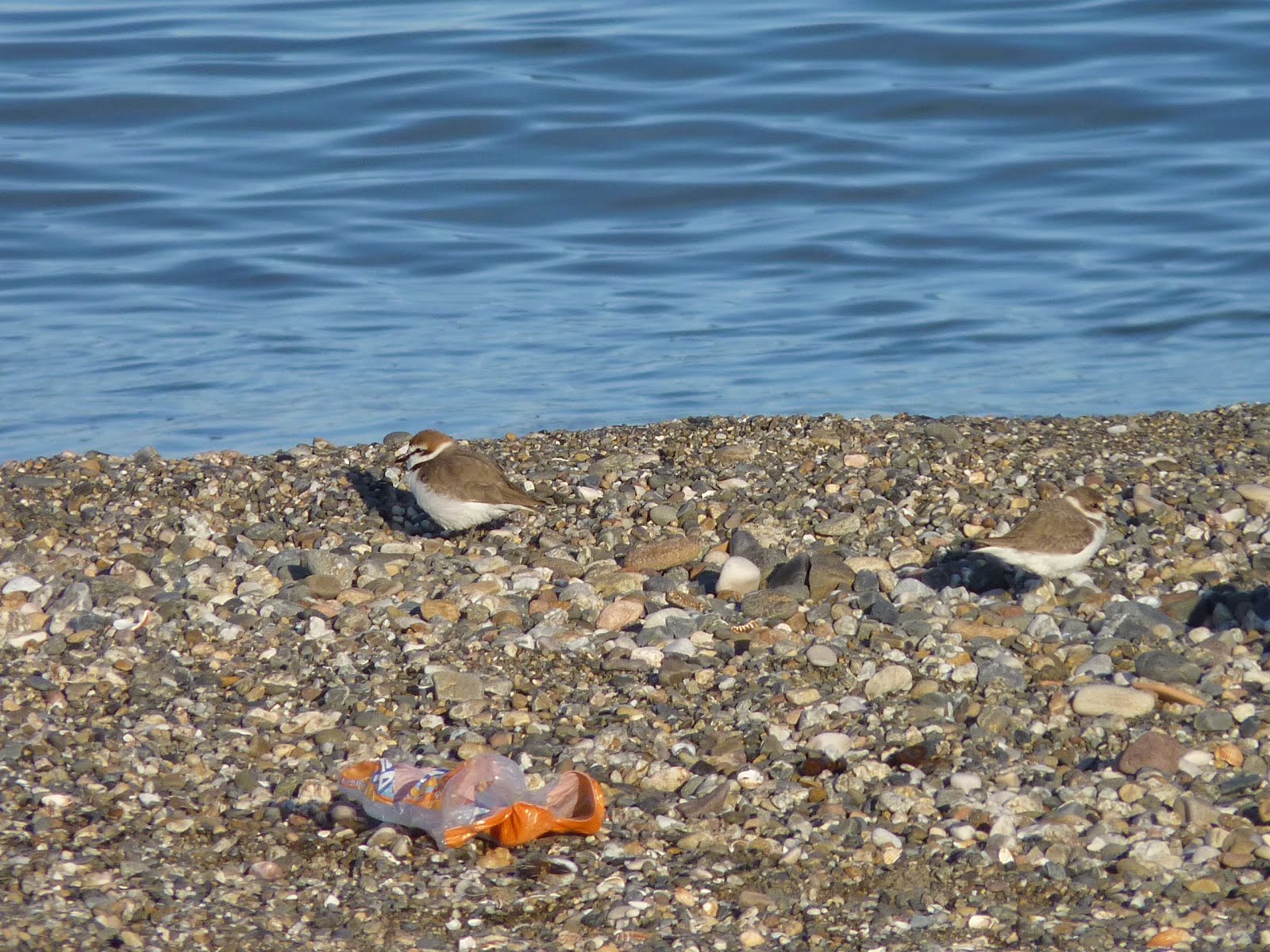
In the wetlands behind the beach was a good variety of species, and the contrapunction of White-Faced Duck and elegant Black-Winger Stilt was very strange.
More later, when the thousands of photos have been processed :-)

Sunday, 18 March 2012

More Fallen Chalk - and the culprits

Another week, another cliff fall - a large one this time, between St Margaret's Bay and Dover docks. It's not quite taken out the promontory from where I watch nesting Kittiwakes, but it's close and some scary cracks have appeared across the turf which indicate that the viewpoint is now even less safe than previously.
I know what (or rather, who) caused this avalanche...... it was the Greater Kent Birder with his enormous equipment, who has spent much of the last fortnight sitting on precisely this bit of chalk watching for Peregrines. And by doing so he got some great photos, see here.
Presumably the weight of his lens was too much for the cliff, which gave way after after ninety million years in existence.

A pair of Peregrines flew across the white chalk scar today, and seem to have taken a liking for a nearby chasm despite the fall and despite the many onlookers on the cliff-tops.

The pair of Ravens that have taken up residence further around the South Foreland were vocal, and were seen flying back to their usual feeding area around Lydden.
John Wooley (in his book on birds' eggs Ootheca Wooleyana) wrote that "In the year 1841 there were three nests on the South Foreland. All the young birds were caught on the sands before they could fly well. I purchased one of them at St Margarets for eighteen pence - a fine well-grown bird".

Ticehurst, writing in 1909, reported that "the Raven, like the Chough, is another of our vanished Kent birds" although pairs bred at the South Foreland and between Dover and Folkestone until the late 1800s.
He ends by stating that "if only protection were given to this fine bird, it might once more re-establish itself as a breeding species in the county". Exactly 100 years later, this has indeed occurred.

Sunday, 4 March 2012

Fallen chalk and fallen wood

I told them...... I said it was more dangerous to fence off the rifle range so that the path was forced along the foot of the cliffs. And look what happened:
The MoD risk assessment obviously got it wrong, and there could be birders or dogwalkers under there.
Or indeed James Bond and his girl Holly Goodhead, who in Moonraker are sunbathing at the foot of Kingsdown cliffs (no, honestly!) but the evil Dr Drax sets off a cliff fall from which 007 emerges miraculously unscathed.
A likely consequence of this fall could be the total closure of the area which would be good for wildlife but a shame for me. At the moment the path is taped off, a precaution which seems to be being universally ignored.

In other news:
A young female stonechat was seen on the range.
The highlight of a trip to Oare was the huge flock of Brent geese (estimated at 1300 birds):

On the botanical front, butcher's broom is blooming....
...... sweet violets are perfuming!....
..... and this stork's-bill could be sticky or sea - any experts out there?
Getting down to ground level, a pleasant stroll around Park Wood failed to find lesser peckers, but while idly picking off bark from fallen branches a whole new ecosytem was uncovered.....

millipedes

centipedes

pillipedes


round-mouthed snails Pomatia elegans


...and a glow-worm larva, the first record of the species in this wood, apparently.


They're all lovely in their own little way.

Sunday, 19 February 2012

I declare the Botany Season open!

The sight of the first coltsfoot flowers of the year is always heartening, especially as this year it came after a week's covering of snow. Mind you, it was darned cold looking for them so that's a reminder that there's plenty of winter left yet.
Looking back at my records, the first blooms in earlier years were found on 24 Feb 2011, 27 Feb 2010 and 17 Jan(!) 2009.

I wondered what hardy insect would be out and about, pollenating these early flowers, but when the photos were enlarged a fly could be seen doing just that, at 2 degrees with a cold north wind.
Other flowers have been open for a while, including gorse of course, awaiting warmer days when bugs and bees emerge from their crevices like groundhogs, blinking in the short-day light.


The blooms of common gorse are in full swing, but while lurking around the industrial areas of Dover's Western docks (OK I was lost) a surprise was found....... dwarf gorse - cool.


So far as I know this is botanically unrecorded in east kent, and it's only known in a handful of places in west Kent, so I were a bit chuffed.


Local birders will know why I was at the Western Docks....... there's a gull there.


I hadn't previously seen an Iceland Gull, let alone a Kumlien's variety, so I guess that's two lifers in one bird. Fortunately a bucketload of scraps was provided to bring it and the other gulls in, and good views were had as it floated on the stiff westerly breeze.


The breeze stiffened firther on Sunday, this time into the cold northerly quarter, so why I decided to visit Foreness I can't imagine. A stupid decision, especially as there were precious few birds to be seen. "Nobody here but us curlews" as they might say.


A little egret was in a warmer place, the River Dour by Morrisons, attracting admiring glances from passing shoppers.


Sunday, 12 February 2012

Bossenden Wood

Bossenden Wood is at the western end of the Canterbury circle woods known as the Blean. In May 1835 a series of events culminated in the Battle of Bossenden Wood when an insurrection against the Poor Law ended with eight dead, and subsequent concern about the use of the army in civil matters led to the formation of a police force.
This weekend the Wood was peaceful, under a blue sky with no wind, and cold covering of snow - perfect conditions to watch the birdlife of a British wood in winter.
The number of 'pecker holes showed how rich the wood is in birds, and the almost constant flitting and calling around us confirmed that there is a greater density of birds here than in most woods. It's a thickly wooded place with little evidence of active management but the place is alive.
An hour's walk gave good views of almost all the birds expected in a wood - the usual tits, treecreepers, nuthatches,
plenty of goldcrests and a firecrest, song thrushes, blackbirds and a redwing, green and great 'peckers and - yes - at least one lesser spotted woodpecker, which kindly stopped its relentless search for food to have a rest and a preen in the treetops.
"Lesser Spotted Woodpecker is one of the most strongly declining bird species in Europe, having decreased at an annual rate of 7% during 1980–2005" (PECBMS 2007, 2009) and the rate of decline has been positively correlated with the incidence of grey squirrel dreys, although the direct cause and effect has yet to be established.
The healthy bird population in this wood has not gone unnoticed by the local photographers, who have baited a convenient log with nuts, and I have to admit to borrowing it for my own purpose, adding a stash of my own and then waiting with frozen feet until something showed up.
First up was a male chaffinch, unimpressed with the unsuitable fare on offer. A blue tit and great tit pairing visited frequently (why are they together?) while a more conventional pair of blue tits gambolled around nearby.
The main target, however, was nuthatch, one of which appeared on a 15-minute circuit, dashing onto the log and then dashing off again, leaving photographic confusion in its wake. Eventually though, it lived up to its name (an old word meaning pecker-of nuts-from-a-crevice-in-a-piece-of-wood - "nuthacker") and stayed around long enough for some portraits.
Other fascinating facts about nuthtches can be found here.

Early signs of spring have mostly been snuffed out by the snow, but hazel catkins remain
with a few female flowers showing crimson in the black and white world.


A dusk walk around Stodmarsh was planned to see mumurations of starlings - one single solitary one was seen (not murmering at all) but plenty of chacka-ing fieldfares flew in from nearby orchards, an obligatory woodcock was flushed and flew around us in a circle, while half a dozen marsh harriers circled over their chosen roost in the reeds, sometimes landing in the small trees.
The sound of footprints in the reeds indicated an unseen heron or maybe bittern, waking a group of bearded tits that pinged in irritation. Squeals of water rails showed they were around, and one scurried along the path like Secret Squirrel, keeping its head down and it won't be seen.
The sun set over the frozen lake, marked with fox-prints showing the constant threat to ducks whose safety is compromised in such conditions. Jupiter shone and Mars glowed, at the end of a perfect day.
And just to finish it...... a gig with Fairport Convention in the good company of friends - lovely.

Sunday, 5 February 2012

Displacement activity

The snow dumped on us last night, and this corner seemed to get as much as anywhere for a change. Powdery snow drifted around leaving some places almost bare while others (including the roads) were deep. The patterns picked out the contours of the beach well as the wind whipped across it in the morning.
Buzzards and ravens have been seen regularly from the A2 around Lydden, and this week there's been an influx of more birds into Kent, with vast flocks of wood pigeons and smaller numbers of redwings and blackbirds, displaced by the cold weather on the continent - unfortunately it has caught up with them here now.

In Walmer Castle paddock a snipe was probing through the snow in a thinly covered area, seeking food.
The countryside has taken on its customary soft look in the snow, with flakes settling on every surface.
And on the promenade the photographers preyed on the photogenic phishing boats - Julie's my favourite, especially as she shelters me from the wind when seawatching.
In such cold times, there's nothing better than a warm pub to displace yourself to, and I can recommend the Just Reproach, the new micropub in Deal which brings a jovial conviviality and good beer to the town, which is already blessed with gems like The Ship and The Berry, where an impressive selection of ales can be found (as well as a group of birders, but don't let that put you off).

A link from the RSPB's Facebook page:
a Bulgarian birding site shows photos of a displaced bittern on a window ledge - that would have been a good Gardenwatch record.