Wednesday, 11 April 2012

Easter Eggs and a Sweet Tooth

The disappointing Easter weekend was mainly spent searching for that strange, elusive plant, Toothwort, which has been reported up north but not yet seen down here. We tried in local woods where I'd seen it before, but no luck.
But other things were good to see:
Bluebells of course, coming out so there'll be a good show this weekend.
Moschatel seems far more plentiful this year, veritably carpeting the woodland floor, as Alexanders is doing across the local verges. Perhaps the early warmth followed by a cold couple of weeks has held other plants back, giving the early starters a longer time to thrive?
Hops are starting to push through the hedgerow litter, looking like feuding adders with their sinewy shoots.

Inland then to the hazel orchards of the Greensand Ridge of west Kent (I'd never seen hazel orchards and had to look closely before I'd believe that was what they are). A bizarre sight to someone brought up amongst the apple orchards, but sure enough that's what they are.
Surely toothwort should prosper among these trees?
But no. Maybe the pigs had eaten them up.

Once more the habitat gave up other things of interest..... bilberry for instance, providing an understory in the otherwise bleak beechwoods.
This leaf miner trail tells its own story. I started small, and ate and ate until I was big..... then I flew away.
Another sight new to me was female hornbeam flowers. I'd seen the male catkins, but not noticed the adjacent females, with subtle pink in the green world.
No pink toothwort to be seen, so that was the end of the weekend. Fruitless. Or rather, toothless. The Easter eggs were good, though.

Bird-wise the highlights included a short-eared owl hunting over Barrow Mount and the golf course at Kingsdown (thanks to Graham for his photo)
and a couple of raptors that could have been honey buzzards flying north near Northbourne.

Back to work in sunshine(!) on Tuesday, and in a wood that can be seen from my office window.....
Would you believe it?
Although we know that toothwort is innocent of chlorophyll and is a parasite, according to Edward Step "it has been believed that some portion of its nutriment is obtained by pursuing the vocation of a trapper of innocent animalicules, which are done to death and digested by it".

Sunday, 1 April 2012

Very Early Spider Orchids

No, not an April Fool's joke..... there really are Early Spider Orchids flowering at Samphire Hoe.
Very small, just an inch high, but the flowers are starting to show.
I checked the rifle range at Kingsdown but there was no sign even of leaf rosettes, but that's not too surprising as it's in the grip of north winds from the long-established weather system.
Coltsfoot is dotted around brightly, attracting honey bees
and flies:Their identities will, however, remain a secret, as life is too short to track them dowm - sorry.

Brimstones are out, and I saw my first orange tip of the year during the week. This brimstone is considering the new season's fashions - do I look better with yellow, or with violet?
Adders are apparently abundant on the Hoe, but we didn't see any in the chilly morning, but this picture was taken last weekend up-county where the weather has been warmer.

Tuesday, 27 March 2012

Meet on the Ledge

A rocky path leads from the Gibraltar bird observatory across the sheer eastern face of the Rock. The path is called the Mediterranean Steps, and is known to be a botanical treasure. This side of the Rock benefits from sea frets and therefore has a lush vegetation rarely seen in the Mediterranean region.
It helps to have a good head for heights and a stout pair of shoes, however. There were plenty of Dwarf Fan Palms which elsewhere in Spain have generally been cut down when small for their fleshy edibly stems.
We saw few species that we recognised from home, but plenty that seemed familiar. This looked like our Butchers' Broom with red berries on the 'leaves' or cladodes, and I think it's Spanish Butchers' Broom.
Nearby a Moorish gecko basked in the sun, motionless, as did a scary 'hopper which was the size of a man's finger.
I liked the various catchflies that we saw, tucked in the limestone crevices.

Back in the mountains, we followed the suggestions of John Butler's excellent Birdwatching on Spain's Southern Coast - a dam over a dry river seemed a waste of time and money, but provided a good habitat for the usual rock birds -Crag Martins and Blue Rock-Thrushes, Choughs and overflying raptors.
Blue Rock-Thrush

Short-toed Eagle

Nearby a lovely bit of habitat had almond trees covered in red-berried mistletoe - a strange sight indeed - and dotted around on the ground were some lovely toadflaxes.
The beautiful town of Ronda is built over an awe-inspiring gorge, with a stunning bridge spanning the gap.
This also played host to the usual suspects, with a sighting of just one Alpine Swift to remind me of the Folkestone visitor a couple of years ago. Choughs chuffed around below us.


Meadow Saxifrage - it grows in west Kent but I've not seen it there.

Nailwort (Paronychia sp. apparently)

Wednesday, 21 March 2012

Gib

Just back a few days in southern Spain, which included a visit to the Bird Observatory on Gibraltar. The views from there are stunning, across to Africa ....
..... and across the bay to Algeciaras.
Unfortunately the Levanter easterly winds were not kind to us, and not one migrant was seen over the three days at the Obs - they would have been pushed over to the more westerly landfall at Tarifa.

To quote the excellent Gibraltar Ornithological and Natural History Society website :

14 Mar: The winds have been a moderate easterly with mainly clear skies for the last few days. This means that there has been no raptor passage and the passerine migrants have gone through mainly undetected with the clear night sky. The ringing effort has therefore produced few birds, with mainly local retraps and some local birds ringed, and included a new Blue Rock Thrush on Monday. Lets hope that the weather system that is producing settled weather over much of Western Europe shifts soon and may bring the much awaited rain fronts our way. If this does not happen soon, we will be experiencing extreme drought conditions, and the vegetation will soon dry out, as it is already showing signs of stress and browning.


That's not a bad view from the well-appointed Observatory, and there were Sardinian Warblers and Black Redstarts in the garden to watch, not to mention the ubiquitous Yellow-Legged Gulls which bizarrely nest in trees on the Rock.
Spotless Starlings nest in the Trafalgar Cemetary.


There are apparently still a few Barbary Partridges left in the area, but these are declining with habitat loss and depredation so are rarely seen. This moth-eaten specimen showed well, however.
The flora on the Rock was varied and fascinating, and a later blog will hopefully cover some of these after some critical analysis. We were greatly helped by Paul, a local member of GONHS, who showed us around and pointed out some of the bird and plant species. He also kindly told us where to find a small colony of Lesser Kestrels on the mainland, without which help I'm sure we'd never have seen them.

They were nesting in holes on a railway bridge and although they quickly flew when we arrived, a little patience paid off and they soon returned, wheeling in the bright sunshine showing their colourful plumage.
The mountains of Andalucia were lovely, but dry. There were plenty of orchid rosettes but few flowers which have presumably been held back by the lack of rain. More birds were seen here, with the pick of them being this juvenile Golden Eagle.

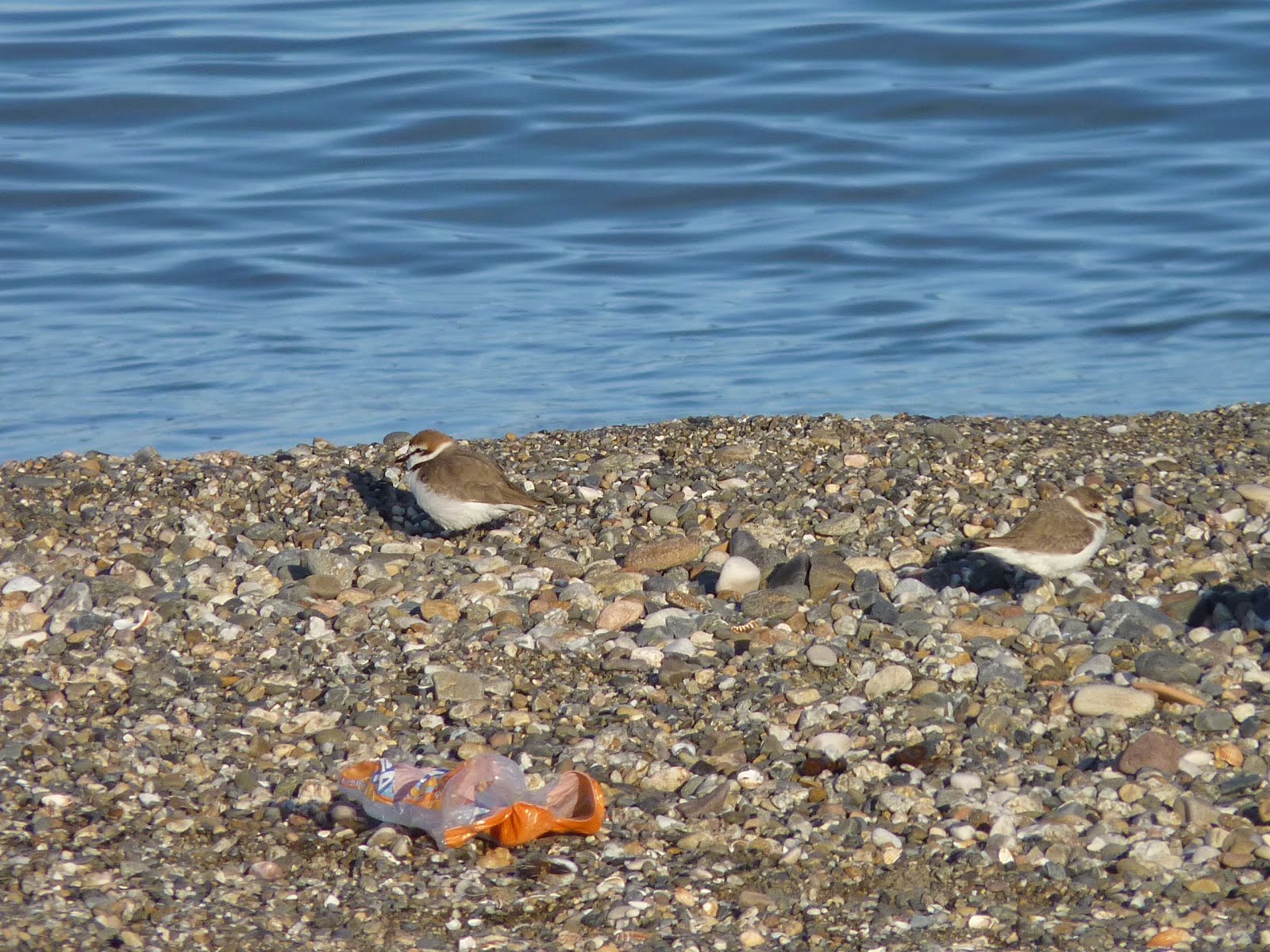
Water was eventually found back at Malaga at the end of the airport runway. The estuary of the Guadalhorce has been made into an impressive nature reserve, where Kentish Plovers were a joy to see. Just look at their little red caps!
In the wetlands behind the beach was a good variety of species, and the contrapunction of White-Faced Duck and elegant Black-Winger Stilt was very strange.
More later, when the thousands of photos have been processed :-)

Sunday, 18 March 2012

More Fallen Chalk - and the culprits

Another week, another cliff fall - a large one this time, between St Margaret's Bay and Dover docks. It's not quite taken out the promontory from where I watch nesting Kittiwakes, but it's close and some scary cracks have appeared across the turf which indicate that the viewpoint is now even less safe than previously.
I know what (or rather, who) caused this avalanche...... it was the Greater Kent Birder with his enormous equipment, who has spent much of the last fortnight sitting on precisely this bit of chalk watching for Peregrines. And by doing so he got some great photos, see here.
Presumably the weight of his lens was too much for the cliff, which gave way after after ninety million years in existence.

A pair of Peregrines flew across the white chalk scar today, and seem to have taken a liking for a nearby chasm despite the fall and despite the many onlookers on the cliff-tops.

The pair of Ravens that have taken up residence further around the South Foreland were vocal, and were seen flying back to their usual feeding area around Lydden.
John Wooley (in his book on birds' eggs Ootheca Wooleyana) wrote that "In the year 1841 there were three nests on the South Foreland. All the young birds were caught on the sands before they could fly well. I purchased one of them at St Margarets for eighteen pence - a fine well-grown bird".

Ticehurst, writing in 1909, reported that "the Raven, like the Chough, is another of our vanished Kent birds" although pairs bred at the South Foreland and between Dover and Folkestone until the late 1800s.
He ends by stating that "if only protection were given to this fine bird, it might once more re-establish itself as a breeding species in the county". Exactly 100 years later, this has indeed occurred.