Wednesday, 25 June 2014

In the rough


Before we notice it, spring has gone and summer has arrived, ushered in by long days, warm nights and the first meadow browns and marbled whites.


The Leas at Kingsdown is a good place to see roosting marbled whites, often head down on the vegetation, and this year the grass here and elsewhere is thick and lush - pity the poor golfers finding their ball in the rough. Also thriving here is the naturalised everlasting pea, so if any long-tailed blues would like to fly over again, there's plenty of food here. Or if any egg collectors have any eggs collected from elsewhere?


Elsewhere, orchids are flourishing in the most unusual of places. Along the A20 and M20 around Folkestone and on the roundabouts there are hundreds of pyramidal orchids, while common spotted orchids on the Western Heights seem to be in thousands.


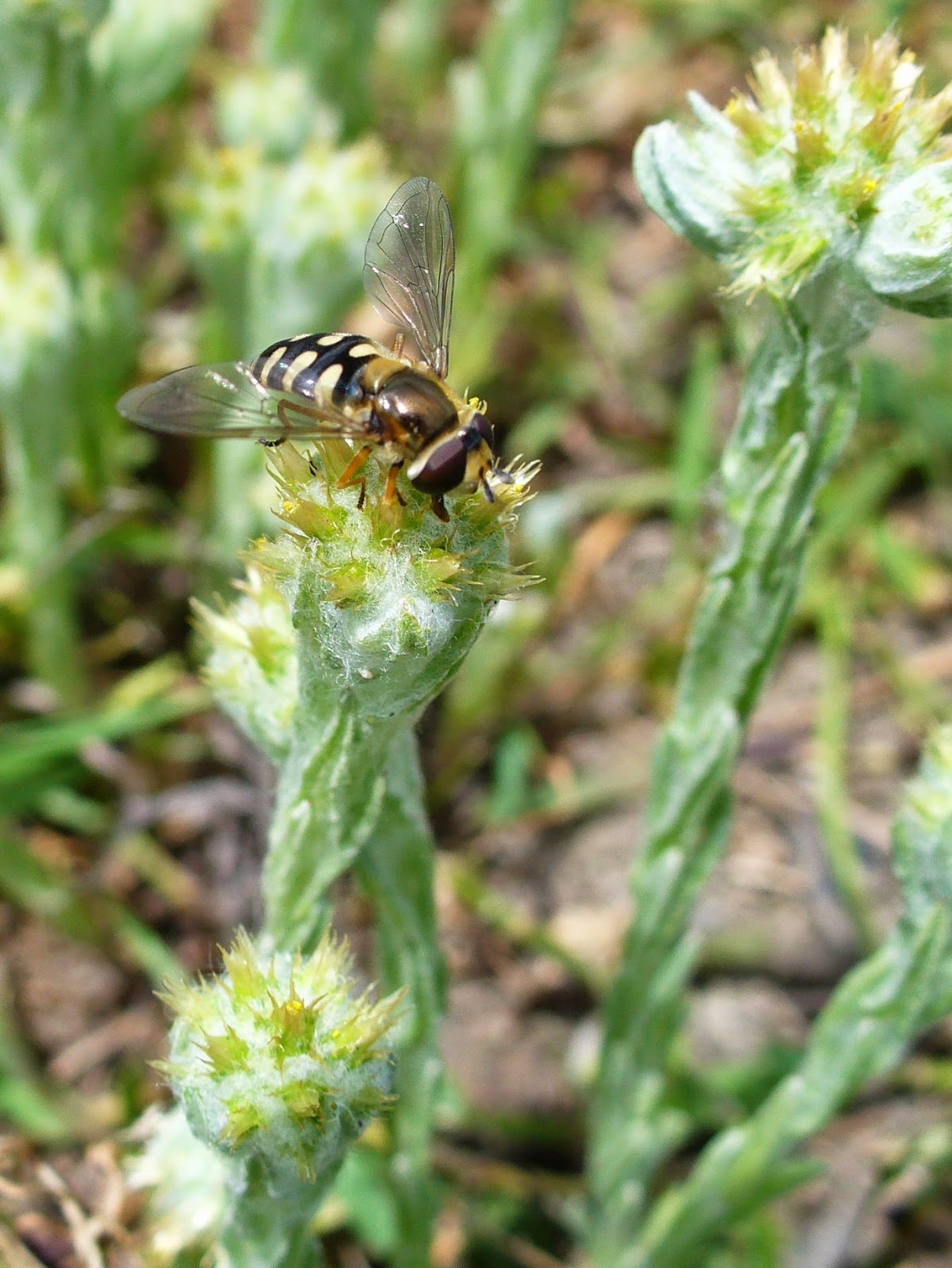
 In the dryer areas of the Folkestone area, however, profusion of another sort is seen - lawns of common cudweed line the A20.

A new plant for me was found under the Eurostar bridge..... fiddleneck Amsinckia micrantha which is a wool shoddy escape, and very infrequent.

Monday, 2 June 2014

So little time, so much to do

It's that dashing time of the year when spring is bursting into summer, and all the joys of the season emerge at once. The temptation is to dash around seeing all the favourites before they fade, fly away or die.

Tick them all off again, even though you've seen them every year for the past three/ten/fifty.
It's mid-May..... I must check on the adonis blues / late spider orchids / nightjars....... even if they are a long drive away on someone else's patch.

Resist the temptation. There's good stuff on your doorstep, or at least there is here, and we know we're lucky in this corner, surrounded by downland, cliffs, the sea and marshes. And the suburbs of Dover, where the Old Park Hill area is being regenerated to bring back the diversity that has (temporarily) been lost after grazing ceased a couple of decades ago.


Or the hills above the housing estates of Folkestone, which are breaking out into a beautiful tapestry of colour as orchids, horseshoe vetch, rock rose and the rest .......


.....and capping each hill top, a plant or two of common gromwell.
At first glance it was easy to see that there were many burnet moth cocoons on grass stems, glaucous sedge spikes and (notably) the fence wires.
 On closer inspection, there were also many, many caterpillars preparing for that stage of the life - they were everywhere. Sit down with care.


Other trips revealed
- three calling cuckoos including a bubbling, egg-laying female on Minster marshes, where at least five nightingales gloriously sang, and occasionally showed themselves - 


                                                   - a tiny grass snake at Sandwich Bay -

- where the "wild" lupins seem to be spreading inexorably. I dislike lupins in gardens, but these seem right in the big-sky marshes - 


- Nottingham catchfly above Dover docks, subject to an informal survey this year -

And OK a bit of plant-twitching....... greater butterfly orchid at Park Gate Down (the Mecca) and an evil sprite masquerading as a fly orchid. 

Wednesday, 21 May 2014

Pale pallida

It's not often that a first plant for Kent is found, but that's what this is:

Look, that small light flower in the foreground, beneath a new fence marking the edge of the National Trust's latest acquisition of cliff-top land at the South Foreland, by the lighthouse.
It's a pale form of scarlet pimpernel (Anagallis arvensis forma pallida), which has apparently been recorded 112 times in the UK, but never in Kent.
The new land, reclaimed from the plough, has been spared the weedkillers this year and is producing a reasonably varied flora from its chalk seedbank. There is an understory of pimpernel, mostly scarlet but about 20 plants of the pallida form, with the more robust wild carrot, mignonette, thistles and even some Nottingham catchfly breaking through the swathe of left-over cereals.

We look forward to the summer months, to see if any arable weeds will show through, and it will be interesting to see how the NT will manage the land if they do - is it better to maintain a remnant arable area (à la Ranscombe) or to rebuild the chalk downland by mowing and/or grazing?
In the same area was found a green hairstreak, and the sky seemed filled with singing and chasing skylarks and meadow pipits.

Also in Dover........
... which is, of course, a town surrounded by interesting habitats, is St James' Cemetery, up the Danes. I assume that it, with its neighbouring cemeteries, were allocated to the various town wards, as each seems to have similar age gravestones and none is full, giving an airy ambiance that is accentuated by the surrounding rolling hills.
St James' seems to be the most interesting, with not only fascinating and poignant war graves but also plenty of mature trees and grassy banks.
One south-facing chalky bank retains a varied flora of salad burnet, rock rose, bird's foot trefoil and the fragrant horseshoe vetch, with attendant butterflies including brown argus, common blue, green hairstreak and dingy skipper.

 Despite the presence of a little kidney vetch, no small blues were seen. But talking of small blues, we stumbled over some old records of JW Tutt this week, which included mention of an aberation of the small blue, cupidus minimus ab. pallida,  - "a rare aberration of the i, in which the ground colour is of a pale
grey tint. The type of this form came from the South Foreland, in Kent, though rare".

It's a small world.

Sunday, 4 May 2014

Hall of Legends


The early part of the Bank Holiday weekend was spent meandering around the byways and hollow lanes of east Kent, pottering around where the fancy took us (and that's not a slur on the quality of the navigator).
Mostly sunny but often chilly, the coolness had the benefit of slowing down the few butterflies that had taken to the air, and so could be photographed more easily.

I think this is the first photo of an orange tip at rest that I've ever achieved.

Green veined white

Sharp eyes spotted some twayblade orchids at the roadside, and sharper eyes then found a host of herb Paris - 70 were counted, which is a good number for this scarce plant.


A passer-by fell into conversation and told us he was the local farmer, so we took care to tell him what a good habitat he has there. He pointed us to a by-way which the book Natural History of the Folkestone District described as "a bridle road running almost due north along a deep valley which in summer is brimming with flowers". That would be overstating the case now, but the farm is working under the High Level Stewardship scheme to restore at least some of the land to less intensive farming.
One surprise was awaiting us, though, in the form of crosswort, which I did not know occurred this far east.


 The farmer also told us that Tappington Hall nearby was holding a fundraising tea party, so - loathe to let a slice of cake go to waste - we turned up as uninvited guests and were made most welcome. It's a lovely old building, hardly updated to the 20th let alone 21st century, and it has plenty of tales to tell.
There's the tale of brothers separated by the politics of the Civil War, who one day met on the stairs and the parliamentarian killed the royalist with an axe. The splintered wood remains but the blood stain has finally gone.
And the tale of Evil Sir Giles, and many others - all recorded in the Ingoldsby Legends in the 1840s by the Rev Richard Harris Barham, who owned and lived in the Hall. 
To complete our social afternoon we met the owner of Denton Court and much of the Denton valley. I'm clearly upwardly mobile now. I could handle the landowning life, I think, especially if the cake is always that good.