Saturday, 16 November 2019

Corsican nature

It's our experience that Italy has few birds but plenty of lizards, while Spain has many birds buttes lizards. These facts are presumably connected.
Corsica has few birds but lizards are numerous.... this one is a Tyrrhenian wall lizard.

Late September is before the autumn rains so most flowering plants were burned off by the summer sun, apart from the ever-present stink-asters on roadsides and old fields.
Watered gardens become havens, therefore, for both plants and their insects.

This autumn squill under coastal pines was an exception.

We had seen two-tailed pashas on previous trips to the Med but only from a distance as they flitted across the Maquis looking for rotting fruit on palms and strawberry trees.
My luck was better this time as a pasha had taken a liking to rotting grapes on a cottage wall and stayed gorging itself while photos were taken.


This was followed by an even more unexpected encounter, when another landed at my feet of a beach, and proceeded to feed off the eelgrass on the sand.


Matching the pashas for size were some great banded graylings on water mint by a dry reservoir.


Birdlife was mostly jays, squirrelling away holm oak acorns like there's no tomorrow.
But one event of interest was a roost flight of little egrets out of the salt pans of Porto Vecchio onto these rocks in the harbour. And having collected strength in numbers, then into some reedbeds.

Meanwhile, back at the holiday village, the ponds were crowded with edible frogs -leaping splashily into the water at my approach.

The autumn rains had not yet fallen, so the island was parched and only stinking fleabane in profusion, and a few other hardy plants managed to flower in the dry soil.


Sunday, 13 October 2019

Corsican seas


Beautiful beaches, full in summer but almost deserted in late September. This one, Palumbaggia, was five minutes drive from the holiday park and empty in the morning.
Crystal clear water and a few rocks means ..... Snorkeling!


Ornate wrasse - male apparently


Peacock wrasse, protecting his mate
Painted comber - reaches 8kg and has sharp teeth

I don't know who you are, but you're very cute

But you know what I am......

Exit octopus, stage left

And I'm a cuttlefish.....  you ain't seen me right?
IDs are from this website: https://www.jasonflower.co.uk/index.php?/category/134 but any errors are mine.


Great fun snorkelling - there's always something to see, especially if you have a little bread or something as bait....


The wonderful beach at Rocapina, reached down a mile--long dirt track which keeps the crowds away.

Sunday, 28 April 2019

20 things to do before......

Looking back on the blog, I see that in 2010 I posted a list of 20 things to do before I'm .... well, older than I was then. 
Some 9 years later, I'm still at work but have similar interests to then, and have accomplished some of these targets already.  Notes are consequently listed below (with links to appropriate blog-posts) and I can now put my mind onto new objectives for the next decade.


  • Watch the waders at high tide at Snettisham  Done, as a kind Christmas present, a few days after that blog-post. Very cold, not many birds, but a lovely experience.
  • Find eagles (Golden and/or Sea) in Scotland  Not even close, but may be achieved on the Isle of Wight soon.
  • See a hummingbird - anywhere   Even further from achieving this.
  • Sit on the rock of Gibraltar, to see the raptor migration  Done this -wonderful time staying in the Gibraltar bird obs.
  • Walk the cliffs around the Lizard in Cornwall - I've been there a few times before, but never with my eyes open for plants    Nope.
  • Visit Ranscombe Farm in north Kent for Corncockles and Cornflowers, Cudweed and Ground Pine   Lovely place, visited a few times and found all these in profusion (except ground pine which I have seen at The Larches and Blue Bell Hill)
  • Clamber over the limestone pavements of the Pennines   Not yet - must be done soon.
  • Find a Late Spider Orchid on the downs  Working nearby, I have seen them at a number of sites but none without help.
  • Visit a place I know where Fly Orchids flower, but for once at the right time  Have done, and have successfully predicted where they may be in new areas.
  • Locate a Long-eared Owl at roost  A very hidden one at Dungeness, pointed out to me.
  • Take a slow boat up and down Norwegian fjords     Nope.
  • Encounter a large wild animal, and survive  Wild boars in Crecy forest - scary.
  • Compare Duke of Burgundy butterflies in Hampshire with the Kentish ones  No, but have found another colony in Kent.
  • Watch Flamingos and Stilts on the Camargue  Yes! And more
  • See Swallowtail butterflies on the Norfolk Broads  Nope. Let's go now!
  • Walk the Breckland on a hot day  Nope. Let's go now! (or when it's a bit warmer)
  • Hear Manx Shearwaters around their burrows at night  Brilliant week on Skokholm.
  • Land on the Goodwin Sands, play cricket and watch the seals  Nope.
  • Clear the scrub from The Lynch to return it to chalk downland.  Tried, but it fought back. Must try again.
  • And finally, 20. Find a Military Orchid in Kingsdown. Or, if not, seek them in a little nature reserve in Suffolk.  No, but found them unexpectedly in Normandy so I am happy.


    So that's 10 objectives achieved, and 10 not yet done. I'm quite impressed by that, and am grateful to the various people who helped me thus far.  I'll add another 10 in due course, to keep me focused.


     The original post.......


    As I've long passed the allotted Two-score Years and Ten, the mind concentrates on things that must be done in the time before the mist rolls in.


    I don't want to be just one of the crowd......
    ....so I need a clear view of what to accomplish:
    So, in no particular order, here's a list of things that I'd like to do, near and far.........

    1. Watch the waders at high tide at Snettisham
    2. Find eagles (Golden and/or Sea) in Scotland
    3. See a hummingbird - anywhere
    4. Sit on the rock of Gibraltar, to see the raptor migration
    5. Walk the cliffs around the Lizard in Cornwall - I've been there a few times before, but never with my eyes open for plants
    6. Visit Ranscombe Farm in north Kent for Corncockles and Cornflowers, Cudweed and Ground Pine
    7. Clamber over the limestone pavements of the Pennines
    8. Find a Late Spider Orchid on the downs, and
    9. Visit a place I know where Fly Orchids flower, but for once at the right time
    10. Locate a Long-eared Owl at roost
    11. Take a slow boat up and down Norwegian fjords
    12. Encounter a large wild animal, and survive
    13. Compare Duke of Burgundy butterflies in Hampshire with the Kentish ones
    14. Watch Flamingos and Stilts on the Camargue
    15. See Swallowtail butterflies on the Norfolk Broads
    16. Walk the Breckland on a hot day
    17. Hear Manx Shearwaters around their burrows at night
    18. Land on the Goodwin Sands, play cricket and watch the seals
    19. Clear the scrub from The Lynch to return it to chalk downland.
    And finally, 20. Find a Military Orchid in Kingsdown. Or, if not, seek them in a little nature reserve in Suffolk.

    The Galapagos should be on there, of course, but places like that need fewer tourists, and the carbon footprint would be frightening.


    Thursday, 19 April 2018

    Looking for spring in Provence

    We went looking for spring in Provence - and found it briefly. Just a bit early, just a bit windy, and certainly too wet - the locals complained in January that there had been no rain for six months and it has made up for it since then, so it was very lush.

    But we had some good sunny warm days, and bizarrely saw alpine swifts before martins or swallows, and heard nightingales before chiffchaffs or blackcaps. There was much history to see
     and there were early spider orchids (ssp passionis) by the pool.

    The drive down through France revealed many joys: the towns of Troyes and Tournus were delightful in different ways, the former a university city that came alive on Friday evening, while the latter is quiet and peaceful - both had water and history, as well as fascinating nature reserves:

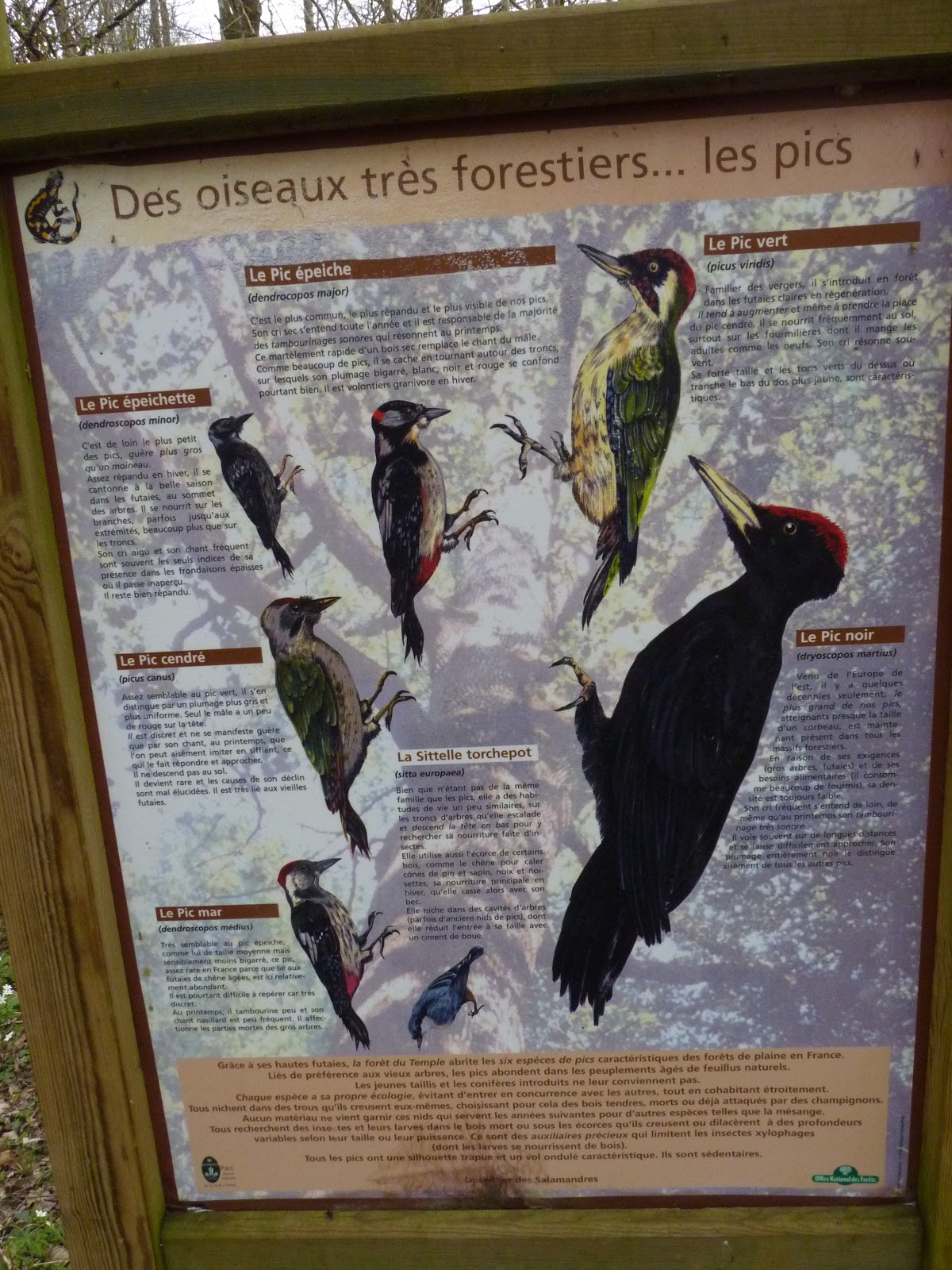
    Outside Troyes the Foret d'Orient had masses of spring flowers as we know them, including many many oxlips. It also has a salamander trail!
    Near Tournus is the Truchere nature reserve, a marvellous collection of woods, etangs and heaths which shows what a healthy ecosystem looks like - middle-spotted woodpecker and wood warblers gave me my best views ever, and the chateau that we stayed in had nightingales and a cuckoo at the bottom of the garden.

    Back to Provence, the number and variety of birds in the countryside were disappointing, and again we were too early for rollers or bee-eaters. We staying the Alpilles hills (pronounced "Alpeeees" according to our strict guide and interpreter) and there is an impressive project to encourage rollers by the LIFE group.

    The limestone flora was beautifully full, prior to burning off in the summer sun.

    I just love limestone, leaping from rock to rock, my best girl by my side....


    The Alpilles are part of a so-called Golden Triange which also includes the Crau desert, which apparently has little bustards, sand-grouse and stone curlew but which is about the most difficult birding terrain I've seen (think Dungeness on a windy day, and then some), and the Camargue which needs no introduction.
     Yes you can see greater flamingoes from the road, and yes there's lots else to see including terrapins crossing.
     There is also the marvellous Capilliere reserve where you can see wild nature up close, including white storks, glossy ibis, wood sandpiper, tree pipits, nightingales (and more flamingoes) - all for 3 euros.
    There's so much to see.... best go back again sometime (preferably in later-April/May).

    Friday, 19 May 2017

    Habeo Blogdt


    It's a bit late for a New Year's Resolution but I really must keep this blog up-to-date. If nothing else it's a good way of keeping a diary and I often look back to see what I saw where and when.

    After a dry April, we now have a wet May, so today's note relates to a historical book, Hanbury and Marshall's Flora of Kent (1899), available online here.

    It's noticeable, of course, that many of the records show that specimens were "collected", sometimes in armfuls, which must have cleared some Just-About-Managing species from an area.  This quote is relevant, but probably not correct in many cases:


    George Chichester Oxenden (1797-1875) an author of satiric verses and parodies, was also an orchid enthusiast who had provided Darwin with several specimens. Oxenden was included on Darwin's presentation list for Fertilisation of Orchids (1862), and his assistance is noted on pp 31 n., 43, and 78 of the same.
    Unfortunately he would not have known Jocelyn Brooke (1908—1966) who lived nearby at Bishopsbourne and collected plants in early life before reforming later on.

    Hanbury and Marshall were obviously impressed with our part of the county, and the last sentence of the description is particularly glowing.

    Most species entries are fascinating, such as that of shepherd's needle, Scandix pectin-veneris,
    which is recorded as "colonist, common throughout the county".  Not so now, with just a handful of sites.


    Thursday, 23 March 2017

    An Orchid for Spring

    Laurie Lee's A Rose for Winter retraces his steps through Andalusia, and we were pleased to retrace some of ours to see more of this fascinating land. Spring is well under way in Spain in mid-March so I'll call this trip An Orchid for Spring.

    Travelling conditions in Spain have improved immensely even since the 1950s, and we were, of course, able to drive into the mountains in comfort. The first stop, after a civilised arrival at Gibraltar airport, was at a migration watchpoint near Tarifa where we were lucky to watch seven black storks and an Egyptian vulture fly in from Africa, astonishingly close across the straits.
    Even luckier, a large boulder by the dirt road held a group of griffon vultures, which had presumably also arrived that day.

     
    Our plans were to explore some new areas along the Atlantic coast and into the hills, looking for birds, bugs and botany, encouraged by reports of a wet winter and a warm spring that should bring on the flowers that we missed on our earlier drier trips. We would be guided again by John Cantelo's Birding Cadiz website and publication, as well as by a new Crossbill book Western Andalusia which he also co-wrote.

    We were also inspired to return to Andalusia by a tantalisingly distant view five years ago of a pueblo blanco which we resolved to visit sometime -
     
    ...  and Olvera did not disappoint. A marvellous setting with church and Moorish castle on a rock, which could be visited for a pittance, with a fascinating museum included.

    The scene is set - the weather (mostly) fine. What will we see?