Wednesday, 4 February 2015

Winter thrushes

'Tis a joy to find birds unexpectedly - in this case in a field next to the main road near Ash, where about 1,000 fieldfares and a sprinkling of redwings, pulling worms from the sodden ground. And in the background in another field.... lapwings and gulls aplenty. Must be good pickings.

The fieldfares were very smart with well-streaked chests, and it's not long till it's time to return to the north to breed.


Not to be eclipsed(!) the flanks of the few redwings shone,


....and their chests were proudly streaky too.

Talking of chests.....

 
The previous week we had a pleasant sunny stroll around Pluckley and Little Chart, to see where HE Bates wrote his books (and we're not necessarily talking about Pop Larkin here - check out his marvellous prose in Through the Woods).
It's a pleasant area and surrounded by orchards, where unpicked apples had fallen unwanted from the trees, to be scavenged by ....
 
.... yes, fieldfares and redwings. The noise was tremendous as they wheeled in flocks when disturbed.
 

Too much like hard work for some.


Monday, 8 December 2014

Costa nature


Just for the record, here's a few pics of wildlife encountered in a warm October trip to the Costa Brava, not going far but just chilling.  
Terabinth.

Calamint

I was pleased to nail a Bath white, after much leaping around after the flighty things.
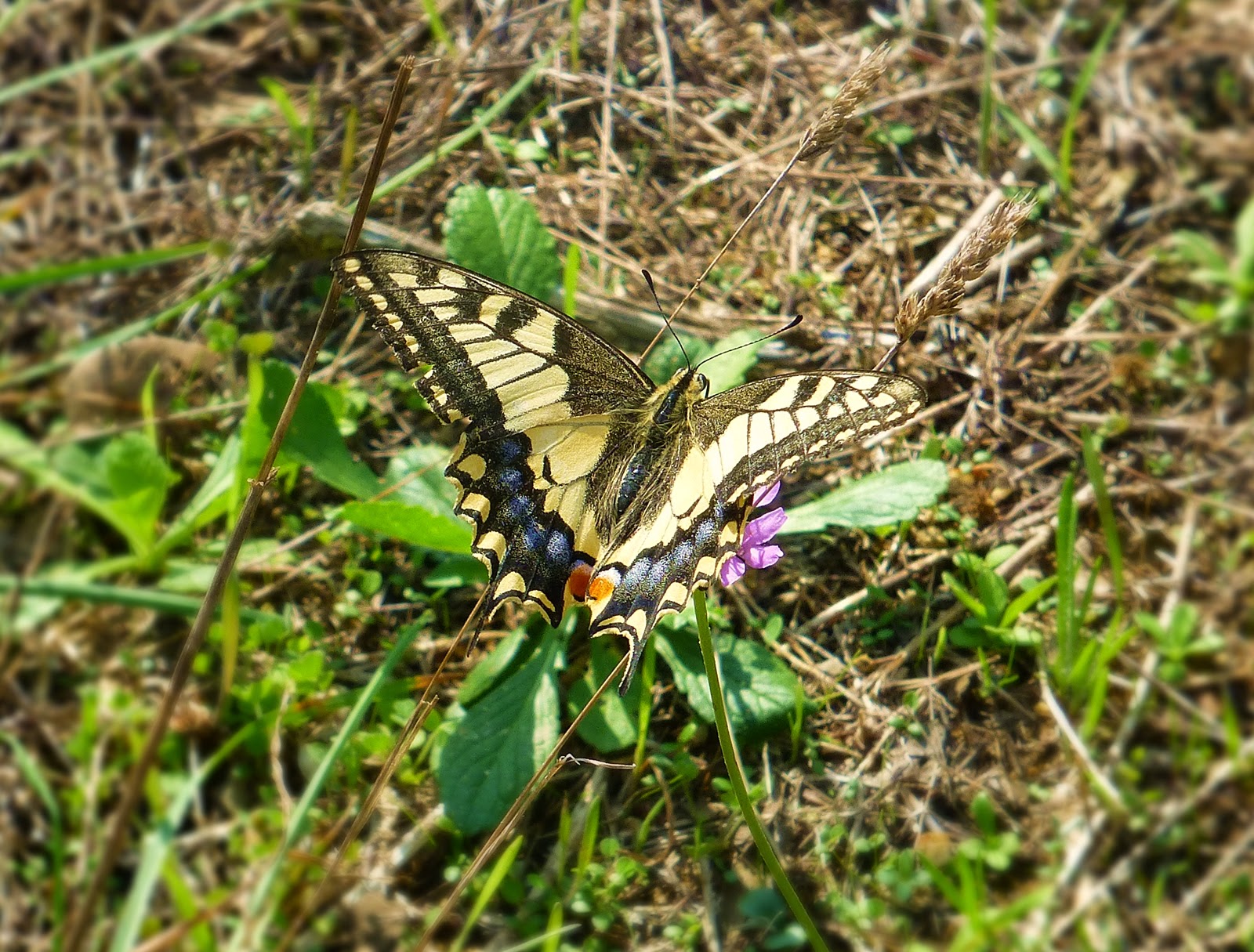
Swallowtails wafted along the well-marked trials - supreme butterflies that had a good year in southern England this year.
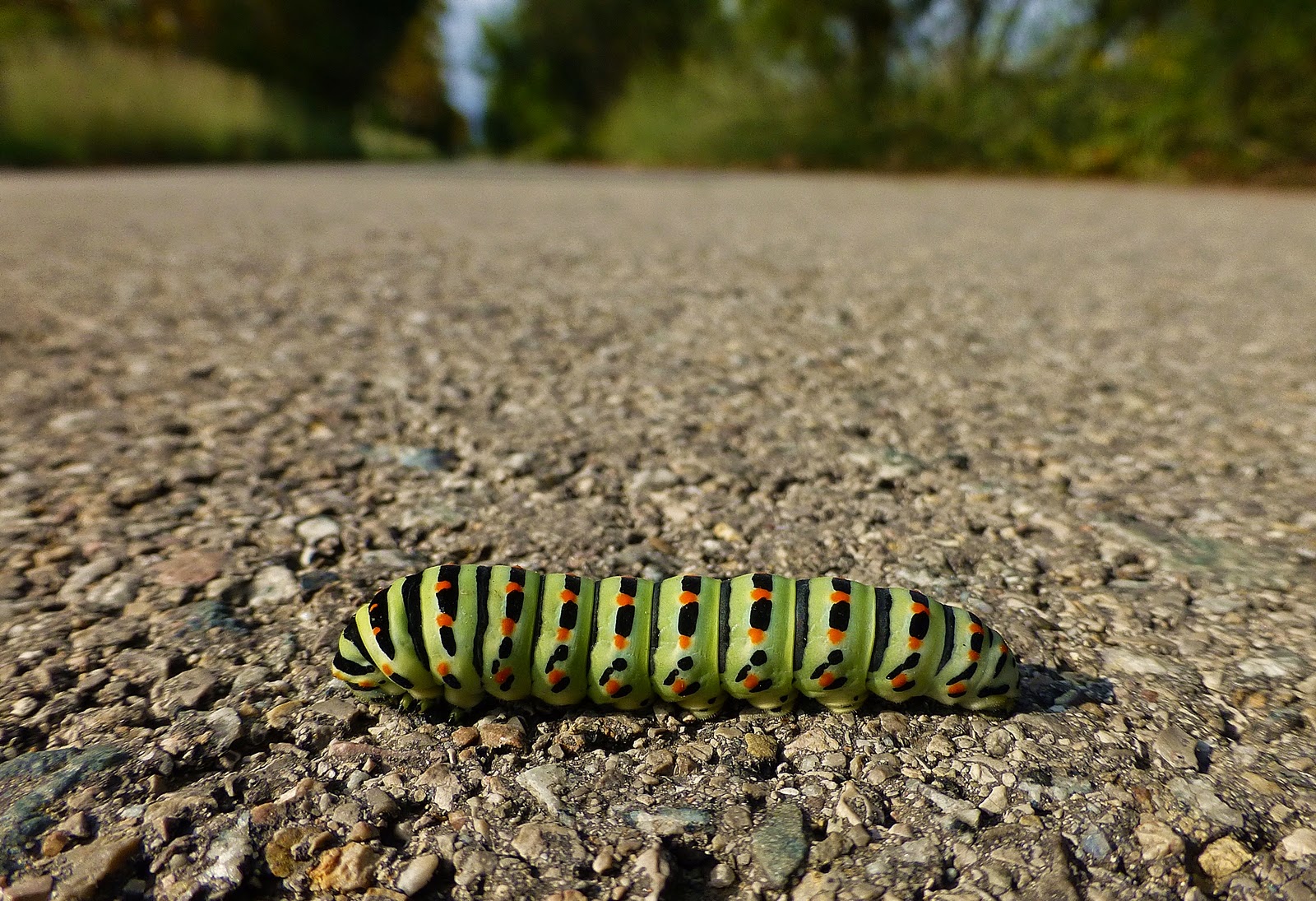
Below is a swallowtail caterpillar crossing the road. It gets upset if disturbed, rearing up and displaying two aggressive prongs (or in scientific terminology, they "evert their osmeterii") and pong.

This, by contrast, is a tree grayling - quiet and camouflaged.

Think this is Iberian lizard. Far fewer lizards here than in Italy, where they are everywhere.

Clouded yellows were common flying over fields of crops.

Also remarkably common were long-tailed blues that frequented low grassland and verges, as well as over fields, not noticeably using pea plants.


The star of the week was, however, the two-tailed pasha that was seen flying around the Jardi Botanic de Cap Roig, clearly attracted to the fruits of palm trees and strawberry trees but maddeningly impossible to photograph.


Above is a narcissus that flowers in autumn, and is common, unlike the unidentified poached egg plant below, found in the marsh under the flightpath of Barcelona airport.

And finally, a death's head hawk moth, sadly deceased, that was found in the street of Calella de Palafruguel.

Sunday, 23 November 2014

Costa Brava in October

In October, we took a hoopoe south to the Costa Brava, where we hoped it would be warm, sunny and relaxing. We had plans to visit nature reserves, wetlands, mountains, cliffs and volcanoes to see many species of birds in Catalonia.


As it turned out, we didn't go far.


It was far from being a beach holiday, but as it was sunny, warm and out of season, the empty beaches and warm sea proved more inviting than getting into the car and driving long distances.

The area around Palafruguell doesn't appear on Naturetrek itineries, but it is not one of the high-rise horrors of the Costa Brava. It's smart and in October you have the place to yourself. There are plenty of interesting and well-signed paths, leading to secluded rocky bays, perfect for snorkeling.


And instead of seeing lots of birds, we were surprised to see plenty of.......... but that will have to wait for the next blog. The habitats above and below may, however give a clue.


Monday, 22 September 2014

Falconry

I have difficulty in deciding on a position to take on the ethics of falconry, just as I have on some other relationships imposed by humans over animals (I'm very clear on many others, though, such as the relationship between Maltese hunters and migrating birds).

However, a  visit to Dover Castle by Rafael Historic Falconry provided both a spectacular display of the falconer's skill and of the birds' mastery of the air, especially when one of the peregrine falcons was set free to soar over the battlements and swoop across the jousting lawn.


Peregrines can be seen frequently along the White Cliffs but seeing them up close gives a new perspective.

I'd not previously seen a gyrfalcon and this one was a beauty, statuesque in line with its image as a Viking's hawk.


One of my favourite authors when I was younger was TH White, who wrote The Goshawk describing his difficult and less than successful attempt to master a recalcitrant Gos. A new book called H is for Hawk by Helen MacDonald has used this as a base for her own more successful story, and usefully points out where White went wrong (driving himself and Gos half-mad with sleep deprivation didn't help).
MacDonald uses more tenderness in place of White's control, but I was reminded of this by the falconer's comment that the bird is not a pet and not a friend; it just uses the human as a source of food.


Friday, 29 August 2014

The "A" word

I refuse to say the "A" word this early in the year, but it's good to see a new colony of "A" lady's-tresses on Walmer beach, about 30 of them where I've presumably overlooked them although they are right beside a path. 

The usual patch by the road is poor this year, with just a handful poking through, while up on the Leas a manic mowing regime has wiped them out for the season.

It appears to be a good year for "A" gentian judging by their profusion on Foxhill Down, Postling Down and the usual little patch in Kingsdown.


Continuing the comparison game, burnet saxifrage seems more abundant than usual, while small and field scabious are scarce - perhaps the former can put its head above the rich sward, while the latter cannot. 

I look forward to seeing the Lydden devil's bit scabious soon, as I have seen my first of the year elsewhere.


Another scabious that's doing well is the naturalised sweet scabious at the root of the cliffs by Ramsgate harbour - a harsh environment of concrete, chalk, pollution and heat that these and other opportunists are enjoying.


Hopefully it will be a good fungus year..........


And finally, it's Folkestone Triennial time again - always a good time. This sign in London struck me as hopeful.....

 ..... and a series of benches have been designed as books - which one is this one?